Sunday, February 28, 2010

Name My Bike


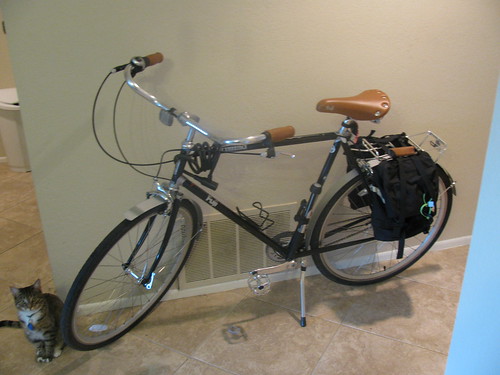
New Bike, originally uploaded by plattypus1.

Some weeks ago, my very generous father (a long-time cyclist, who I wrote about in my last post) decided that I needed to replace my cobbled-together second-hand Magna mountain bike (bought in bad shape at the UCR surplus sale for $10, and made serviceable by a lot of sweat and spare parts) with a quality, properly-tuned city bike. Quite a bit of money later, and I am the proud owner of a 2010 Fuji Cambridge, a beautiful machine that feels positively at home on our city's roads. I also got a day's lesson on the proper care, maintenance and repair of said machine. I'm left with only one problem-

She hasn't got a name yet.

My last bike was named Nessie, because she's heavy, green and uncooperative. I haven't yet found a name that quite fits the new bike yet, so I leave it up to my loyal readers. Leave your suggestions in the comments. If it's particularly good, I may even get one of those bike license plates with her name on it.


UPDATE: Sorry if this wasn't clear... like most vehicles and vessels, she's female. Though commuting with Bruce Willis would rock.
UPDATE: Thanks to my wife, she's been dubbed Chloe.

Saturday, February 27, 2010

Utility Cycling

So I had a bit of a discussion with frequent commenter k in the comment thread on this post about the difference between cycling for fun and cycling for transportation. Of course, the two overlap by a great deal: many recreational cyclists have been known to go places on a bike, and many utility cyclists (myself included) have been known to both enjoy riding while going somewhere, and to ride just for the joy of it on occasion. My father was a world-class mountain cyclist, and he also pedalled around town- I have memories of him hauling around my three, four and five-year-old self around in a yellow bicycle trailer through the streets of Fremont, and of driving off the mountain to pick him and his bicycle up and take both home. (He'd ride all the way to Palmdale from Wrightwood to work as a bike mechanic, and then would ride back to the foot of the mountain off SB County N-4, and my mother would meet him in her car with a bike rack. He's since gone on to teaching in a special education classroom.) The point is, without delving too much into my family life, there is substantial overlap between cyclists who do it for sport, fitness and recreational reasons and those who ride to get places. However, there is a difference between the two when we consider how we plan cycling facilities and our cities for cyclists, and I'd like to examine that difference.

The Sport/Recreational Cyclist:


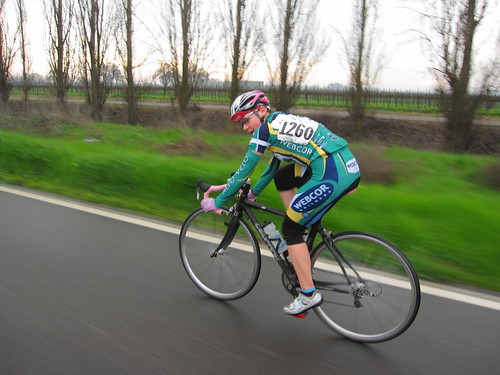
This is often the image that comes to people's minds, at least here in the US, when you say the word "cyclist"- folks dressed in lycra pants and jerseys (often covered in logos), riding for the purpose of riding, and usually for the purpose of going far and fast. You often see packs of these folks out on our roadways on any given weekend, and a 40-50 mile ride is commonplace for them. They aren't trying to go anywhere in particular, or if they are (as is often the case- they meet up at the bagel shop in the Canyon Crest Towne Centre), they're doing it via a long and circuitous route designed to provide exercise. Often, they are competitive cyclists that compete in organized races, and are riding as part of a training program. Organized clubs of cyclists like these are very common, and Riverside hosts a very large one, as do many other IE cities. Recreational cyclists can often be seen advocating for cycling facilities along roadways, such as bike lanes and bike route signage, and are often the primary impetus behind recreational trails like the Santa Ana River Trail and the Victoria Avenue bike path. They can also be seen driving to ride meeting locations with bikes on car-mounted racks, and driving away again afterwards. While they are all cyclists on the weekends, many are the very motorists I am fighting against on the weekdays. And one last thing- the fact that many people think of recreational cycling when (if) they think of cycling at all leads to the impression that cycling is a sport (requiring special clothing, like Lycra pants), and that bicycles are toys or sporting goods (not serious tools for transportation).

The Utility Cyclist:


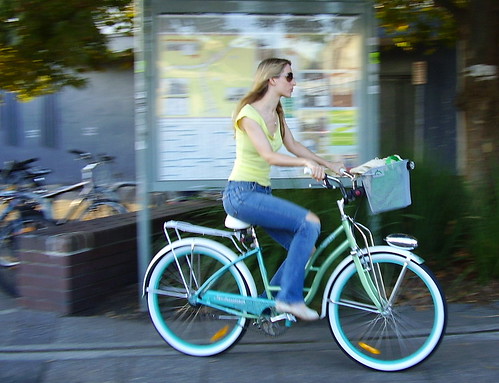
This young lady in Sydney, Australia demonstrates nicely the differences between the recreational cycling that already exists, and the sort of utility cycling that we need desperately to advocate for. Notice first the differences in equipment- she's wearing everyday street clothing, and her bicycle is obviously designed for comfort and carrying capacity (unlike racing cycles, which are often designed to be as light as possible, and omit such niceties as cargo racks and baskets). Second, the girl in the second photo looks entirely natural- while she's riding a bicycle, the bicycle is not the point of whatever outing she's on. This is the difference between driving a car in a rally or race, and simply running errands around town. Now, the girl in the second photo is actually making a "trip" that would otherwise have to be accomplished by automobile, and she has different needs from the sport cyclist. For example, she'll probably be parking her bicycle wherever she's going, rather than simply returning home or to her car's bicycle rack, so she'll need secure bicycle parking. Second, she's probably got a specific destination or two in mind, so she can't always just plan her route based on where the city has provided cycle facilities. If you're just out to ride 50 miles, then 50 miles on the Santa Ana River Trail are as good as any other miles, and you'll probably avoid roads without cycle facilities as much as possible. If, however, you're meeting friends at a restaurant, you might find that the street that restaurant is on has no bike lanes. I am always annoyed at the location of the Santa Ana River Trail- I love to ride it, because it's quiet, well-maintained and car-free, but it doesn't *go* anywhere- in most cases I'd have to ride to the other side of the city, take the trail, and then ride halfway back across the city. (I find Victoria a touch more useful, but it still has this problem.)

The point is that the needs of different classes of cyclists are very different, and we should be actively encouraging cycling specifically as a form of transportation. While recreational cycling is undoubtedly a good thing (it keeps people healthy and has supported a vibrant bicycle & bike part market, and it's fun!), it is not the sort of cycling that creates vibrant urban environments and solves our transportation and land use problems.

Photos are courtesy of swoo and Velovotee via Flickr, used under Creative Commons. See original photo pages for license details.

Wednesday, February 24, 2010

On Eastside Privilege and Cycling Equality

Yesterday was an interesting day. My wife decided she'd leave her headlights on, necessitating a mid-afternoon jaunt (read: sprint) across town to help her jump-start her car. She was at a job interview off of Tyler & Keller in Arlanza. I was just getting out of class at UCR. Google Maps shows the trip taking ~28 minutes by car on surface streets- I got there in 35 with bike and bus. (So, for anyone who says alt transport is too slow, perhaps you're just not fast enough.) Anyway, I'm mentioning this because I noticed something very distinct while cycling through Arlanza- no bike infrastructure. Tyler St. has a "proposed" bike lane, Jackson St. has a "proposed" bike lane, Wells St. has a "proposed" bike lane... let me tell you, proposed bike lanes make for a very lousy ride. Even Arlington has no bike lane through much of the west side of the City, between Van Buren and California. That is a VERY busy stretch of road with a "proposed" bike lane on it. Transit service, once you get off of Arlington or Magnolia, is also pitiful. The area I rode to is serviced by the slow, meandering, something-like-once-an-hour (but not clock-face scheduled) route 13. I was also shouted and nearly run off the road by several drivers, who don't make that mistake nearly as often here near campus. My point is that there is a MASSIVE disparity in the quality of alternative transportation opportunities just within our City. Around UCR, transit is relatively frequent, bike lanes are clean and plentiful, and most of them connect to each other. The further west you go, the worse it gets. Arlanza is, of course, an otherwise-troubled neighbourhood, but that's all the more reason to extend good-quality transit and cycling facilities there.

Another point- because of yesterday's hectic day, I ended up driving my wife to school, and subsequently driving her home. On the way there, I was complaining about how drivers make stupid manoeuvres around cyclists in a selfish attempt to shave a minute or two off their trip, endangering themselves and other road users in the process. What I realized driving home is that drivers treat other motorists EXACTLY THE SAME. Cycling has reached equality! We're treated just as bad as other drivers!

Tuesday, February 23, 2010

Quote for the Day

Getting people out of their cars requires a combination of strategies, from the passive – such as compact development, pedestrian and bicycle paths, and substantial public transport – to the draconian – restrictions on parking, taxes on driving, limits on car ownership, and moratoriums on highway expansion
--Bruce Stutz, "New Urbanism and Eco-Towns: Tackling Urban Sprawl" from Carbusters issue #38

Saturday, February 20, 2010

Bike Deaths Move Inland

Anyone who's read any blog or newspaper article on cycling in Southern California knows that Los Angeles is in the midst of an epidemic of hit-and-run collisions, some of which have been fatal. Well, the IE has joined LA- a cyclist and his brother were injured, the former fatally, in a hit-and-run crash in northern San Bernardino. Thomas Joseph Meeks and his brother were struck by a 2000 or earlier white Chrysler or Pontiac, with the surviving victim adamant that it was a Chrysler. The vehicle would have damage to its front end and license plate. If you have any information about the incident, please contact SBPD Sgt. Rich Lawhead at 909-384-5738.

Motorists- learn to share the road. If I hit you, I put a scratch or a dent into your 2-ton steel monstrosity. If you hit me, I go to the ER at best, and possibly the morgue. Remember that you are in control of a deadly weapon whenever you are in the driver's seat, and act accordingly. And, if you are in an accident, PULL THE FSCK OVER.

I hope the driver gets a very long stay in prison for this one.

Service Cuts. Again.

Really, I'd love one day to get up and post on this blog about the massive new service expansion that RTA is planning. If only RTA would get around to planning one. At least I have good news to report about the City from time to time.

Nope, here I get to fire up the 'ole intertubes and tell you all about the latest service cuts that our meagre little transit system is going to suffer from. And this time around, Riverside is most certainly NOT spared.

The bulk of these cuts are to weekend service, most of them eliminating one trip in the morning, one in the evening, or both. Routes that are seeing cuts of this kind are: 10, 11, 12, 13, 19, 20, and 27.

The following routes are losing more than one trip on either end of the schedule on weekends: 16, 18, 20, and 21.

The 13 is losing the first morning run westbound, and is also losing a weekday school tripper. (If a school tripper is under consideration for cancellation, I support it- if those buses aren't packed, something's wrong.)

The 14 is losing a trip in each direction on weekend mornings, and two on Sunday mornings. The service frequency will also be "expanded" (downgraded) from 70 to 80 minutes. As if it wasn't bad enough already.

Routes 32 and 42 are losing weekday morning trips, with 42 also losing a mid-afternoon run (another school tripper). The 42 will also be "expanded" (downgraded) on weekends from the current 50 minutes to 140, probably the most egregious cut in this proposal.

Route 57, the Temecula Trolley, will be cut entirely. This route had the same failings as route 52 (in that it only runs for a few choice hours a day), and has now lost its funding. No surprise here, and really no loss.

There's one route left, the 25, but I first want to talk about these nighttime service cuts generally. Somebody at the Southern California Transit Forum, and I forget who, made a very good point- nobody wants to be on the last bus. No matter when the last bus of the night is, there will always be depressed ridership, because nobody wants to miss that bus. RTA is cutting a lot of these nighttime buses because they have low ridership, and they may find that the low ridership will simply move back a trip.

Now, on to the 25, the only route to see route modifications. Aside from the weekend trip reductions, and an "expansion" (downgrade) of frequency from 70 to 80 minutes, RTA wants to remove the section of the route that travels along Barton through Grand Terrace and Loma Linda, replacing it with freeway running along I-215 and I-10, from Barton to Anderson. This is a spectacularly bad idea. My wife drives that stretch of freeway often, and I've had occasion to enjoy a drive along Anderson from Barton to the 10. These are highly, highly congested corridors. I usually exit the freeway at Mt. Vernon and take Barton over the hills, simply to avoid the heavily-trafficked mess that is the 215 south of Colton. Not to mention Anderson St., which is a narrow road controlled largely by stop signs, and one that is handling far, far too much traffic for its size. I fully support the RTA's idea of discontinuing service along Barton in San Bernardino County- Omni already runs half-hourly service there, and RTA isn't paid for by San Bernardino County residents, let's be honest- but freeway running is NOT the way to do it. Instead, I think that RTA should run the 25 as a closed-door service, eliminating all stops between the current last stop in Grand Terrace, Barton at Glendora and running directly to the VA Hospital. Alternatively, the route could discharge only while travelling northbound past Glendora, and pick up only while travelling southbound, but I think this would be confusing for riders who aren't used to such arrangements. The surface streets may be slower at some off-peak times (though probably not most), but the added reliability of schedules on the surface streets will be a definite asset to the route. Freeway running will make things miserable for anyone that rides #25, and furthermore will end all service into Grand Terrace proper. (Yes, I know Grand Terrace is in San Bernardino County, but the 25 is currently their only public transit. Perhaps RTA could pursue funding from SANBAG or the City of Grand Terrace for the portion of the route that runs in their county?)

Public meetings are scheduled to solicit input on these service cuts. Let me first admonish anyone that the best way to advocate for a particular trip or route is to come up with a way to fund it, and the second-best way is to show a need that is met by this route that is essential, and that will go unmet if the route is cancelled. That said, here's the meeting schedule:

Monday, March 1

10:00 Multipurpose Room, Corona City Hall
400 S. Vicentia Ave., Corona, CA
Route 1, Corona Cruiser Red & Blue
14:00 Lake Elsinore Senior Activity Centre
420 E. Lakeshore Dr., Lake Elsinore, CA
Route 7
18:00 Moreno Valley Council Chambers
14177 Frederick St., Moreno Valley, CA
Routes 11 & 20

Tuesday, March 2
10:00 East Room, San Jacinto Community Centre
625 Pico Avenue, San Jacinto, CA
Routes 42 & 74
14:00 Room R1, Kay Cisneros Community Centre
29995 Evans Rd., Sun City, CA
Routes 40 & 61
14:00 Craft Room, Mary Phillips Senior Centre
41845 Sixth St., Temecula, CA
Routes 23, 24 & 57
18:00 Perris Council Chambers
101 N. D St., Perris, CA
Routes 19, 27 & 30
Short walk from Perris Transit Center, Routes 19, 22, 27, 30, 74, 208, 212

Wednesday, March 3
10:00 Room 2, Beaumont City Hall
550 E. 6th St., Beaumont, CA
Route 210, Pass Transit 2, 4, and Calimesa Route
18:00 Board Room, RTA Headquarters
1825 Third St., Riverside, CA
Routes 10 & 13
Short walk from 3rd & Chicago, Routes 1, 16, 22, 25, and 51
(If you want to say hello, I'll be at this meeting.)

You can also, as always, comment via e-mail at comments@riversidetransit.com, calling 1-800-800-7821, or writing to:
Director of Planning
Riverside Transit Agency
1825 Third St.
Riverside, CA 92507

Friday, February 19, 2010

This is what we're dealing with


I've spoken before about the stigma of riding the bus. This is a wide-spread, pervasive stereotype that is whittling away at hope for a more sustainable transportation future. It clouds any and all discussions of public transport, and this auto ad shows that marketers are happy to use it as a club against us. This ad was run on bus shelters in Canada, until multiple transit agencies complained and had it taken down. (via Copehnagenize)

(The Green Idea Factory photoshopped this nicely. Also, RTA has proposed some more service cuts, and I'll be analyzing those when I get the time this weekend. You should check the schedule for public meetings and yell really loudly at them.