Since I'm apparently the last person to get the memo about how Long Beach is a pretty cool place, I wasn't quite sure what to expect when I (got up really freaking early and) took the train down to meet a cycle tour through the city, led by Charlie Gandy. I was pleasantly surprised. I formerly thought that one had to at least venture to northern California to find the kind of pleasant urbanism that Long Beach has cultivated.
I don't think there's anything to be found in the city that would be a surprise to most participants in the livable streets blogosphere. Bike boulevards, bike lanes, sharrows, separated cycle tracks, and the famous green lane along 2nd Street are all things that I've seen, in various incarnations, in San Francisco, Los Angeles, Portland, New York, even Riverside and Corona. What is astounding, however, is the consistency and sensitivity with which these treatments were applied. Bike boulevards were placed where elementary school children were likely to ride, bike lanes along quiet streets, sharrows when absolutely necessary. The ocean-front bike path has a separate space for pedestrians, and (according to Mr. Gandy) will soon see a gravel jogging path set off from the bikeway.
What is also astounding is the way that the City's bike team has managed to raise political will and rally local business and community leaders around cycling and livable streets. I won't steal his thunder, but if you go on the tour, Mr. Gandy will rattle off statistics-- numbers of jobs created, businesses opened, sales increased-- and anecdotes of meetings between the City and business owners. The magic argument in Long Beach seems to be that bikes are good business-- and it helps that that argument is demonstrably true.
The thing that really struck me, though, was how cycling and pedestrian facilities could wipe away a lot of the damage done by cars and car culture in a city, especially one with relatively strong fundamentals-- a complete street grid, neighborhood businesses, a relatively concentrated downtown. These characteristics are ones that Long Beach shares with Riverside, and so seeing the improvements that Long Beach managed in just a few short years gives me hope for our own fair city. I think the battle will be harder here-- for one thing, our city is settled at about half Long Beach's density, and we lack the same sort of transit infrastructure-- but with a little luck, and a little experience, I think we can win.
Mr. Gandy will be leading another tour for Riverside officials and activists, on the 14th of July. The tour begins at 10am at Long Beach City Hall-- you'll just make it if you take the 6:20a Metrolink to Los Angeles, followed by the Red and Blue Line Metro trains. Bring some money for a delicious Mexican lunch at Lola's, and please RSVP to Brandi Becker (brandi [dot] becker [at] riversideca [dot] gov) if you'd like to attend. Bikes recommended, but one can be provided on request.

Showing posts with label worth saving. Show all posts
Showing posts with label worth saving. Show all posts
Friday, June 22, 2012


Monday, March 12, 2012
Downtown is Special
Lamenting the under-use and massively wasted potential of our downtown is a regular habit of Riversiders. We all think that downtown Riverside is somewhere pleasant to be, somewhere special, and yet somehow lacking in a way that we never actually end up going down there for anything useful, besides city government. And, it turns out, that most Riversiders (at least the ones that I keep running in to) all have their finger on exactly what the problem is:
Whenever I hear this argument, I alternate between feeling sick and feeling an overwhelming rage rise up within me. It has taken a lot of practice to get to a point where I can calmly, rationally, and efficiently demolish this argument when I encounter it... and yet it keeps popping up.
Okay, Riversiders, listen up, because I've got a few fundamental truths about cities for you. First, cities are populated by people. Not cars, people. Second, paid parking generally means that a lot of people want to go to a place-- so many people, in fact, that there's not enough space to store all of their cars. Third, parking lots are great places for cars, but not terribly pleasant places for people-- they're so unpleasant, in fact, that they destroy neighborhoods.
Knowing these things, we can derive that downtown is a special, unique place within the city. It's the one place (that's not a college campus) where automotive dominance is not complete, the one place where walking to get around is normal. That's what we like about downtown, everybody! We like being able to walk places, to feel the sun on our faces, to wave at our neighbors, to not have to worry about several tons of metal passing all around us all the time. We like the density, the passersby, the feeling that this place was built for human beings, not automobiles. That's what's so special and unique and wonderful about downtown-- and the reason we're all lamenting its failed potential is that this vision is not quite realized. Huge parts of downtown have been rebuilt to cater to cars, and all of it has been forced to conform to single-use zoning. (More on the latter later.)
We can also see that adding free parking would destroy that- in one of two ways. First, if the City were to add a small section of free parking and not expand the parking system downtown, it would generate massive amounts of traffic circling in and around and through that area in hopes of snagging one of those elusive free parking spots-- because everyone should have the right to dump a ton or so of their property on public land at no charge-- and the traffic would harm the pedestrian environment wherever it went. (Not to mention, it would make going downtown an exercise in road rage.) Second, though-- and this is the more plausible scenario-- it would create a demand for more free parking. Surely, if we can make one lot free (and hey look! That lot's always full, it must be bringing people downtown), we can do it for every lot! And now they're all full, and there's no parking downtown, so we'd better bulldoze a building and blow your tax dollars on paving over the resulting empty lot. Give this process 10 years or so, and downtown will be even more choked by pavement than it already is.
No, what we really need downtown is not more cars, but more people. Remember that phrase above about single-use zoning? Yeah. When downtown was built, all of those little doors in the sides of buildings led up to apartments. Now they lead to dance studios and legal offices. Neither dance studios nor law offices are bad things, but neither produces a whole lot of activity outside of business hours. Apartments, on the other hand, mean that the people who are living there come and go at all hours of the day-- and, furthermore, that they're likely to shop in the area, creating demand for grocery stores and drugstores and coffee shops and restaurants and bars all the amenities of urban life that downtown currently lacks, like dry cleaning and 24-hour store hours. If you want to revitalize downtown, the solution isn't parking, it's people.
You have to pay for parking. If only the City would make parking free, we could stop going to the Plaza or Tyler Mall and go downtown instead!
Whenever I hear this argument, I alternate between feeling sick and feeling an overwhelming rage rise up within me. It has taken a lot of practice to get to a point where I can calmly, rationally, and efficiently demolish this argument when I encounter it... and yet it keeps popping up.
Okay, Riversiders, listen up, because I've got a few fundamental truths about cities for you. First, cities are populated by people. Not cars, people. Second, paid parking generally means that a lot of people want to go to a place-- so many people, in fact, that there's not enough space to store all of their cars. Third, parking lots are great places for cars, but not terribly pleasant places for people-- they're so unpleasant, in fact, that they destroy neighborhoods.
Knowing these things, we can derive that downtown is a special, unique place within the city. It's the one place (that's not a college campus) where automotive dominance is not complete, the one place where walking to get around is normal. That's what we like about downtown, everybody! We like being able to walk places, to feel the sun on our faces, to wave at our neighbors, to not have to worry about several tons of metal passing all around us all the time. We like the density, the passersby, the feeling that this place was built for human beings, not automobiles. That's what's so special and unique and wonderful about downtown-- and the reason we're all lamenting its failed potential is that this vision is not quite realized. Huge parts of downtown have been rebuilt to cater to cars, and all of it has been forced to conform to single-use zoning. (More on the latter later.)
We can also see that adding free parking would destroy that- in one of two ways. First, if the City were to add a small section of free parking and not expand the parking system downtown, it would generate massive amounts of traffic circling in and around and through that area in hopes of snagging one of those elusive free parking spots-- because everyone should have the right to dump a ton or so of their property on public land at no charge-- and the traffic would harm the pedestrian environment wherever it went. (Not to mention, it would make going downtown an exercise in road rage.) Second, though-- and this is the more plausible scenario-- it would create a demand for more free parking. Surely, if we can make one lot free (and hey look! That lot's always full, it must be bringing people downtown), we can do it for every lot! And now they're all full, and there's no parking downtown, so we'd better bulldoze a building and blow your tax dollars on paving over the resulting empty lot. Give this process 10 years or so, and downtown will be even more choked by pavement than it already is.
No, what we really need downtown is not more cars, but more people. Remember that phrase above about single-use zoning? Yeah. When downtown was built, all of those little doors in the sides of buildings led up to apartments. Now they lead to dance studios and legal offices. Neither dance studios nor law offices are bad things, but neither produces a whole lot of activity outside of business hours. Apartments, on the other hand, mean that the people who are living there come and go at all hours of the day-- and, furthermore, that they're likely to shop in the area, creating demand for grocery stores and drugstores and coffee shops and restaurants and bars all the amenities of urban life that downtown currently lacks, like dry cleaning and 24-hour store hours. If you want to revitalize downtown, the solution isn't parking, it's people.
Friday, April 29, 2011
San Bernardino = Yucca Valley?
You might as well put this thing in Yucca Valley.
That was one San Bernardino resident's reaction to the soon-to-be-built sbX bus rapid transit system along the E St. corridor. The man's other statements included calling the project a "boondoggle"-- which seems to be a word that means "non-automobile transportation" in Angry Old White Man-ese-- and saying that we need to "fix our freeways and the problems we have now," leaving open the possibility of constructing "this thing" later.
Most of the complaints in this article from the PE's ever-excellent Dug Begley are familiar-- businesses along the line are convinced that the change in traffic patterns along E street, making turning left more difficult, will mean that customers won't drive to their businesses-- and, of course, nobody who rides the bus has ever purchased anything in their lives. But Mr. Ott's assertion that the system will fail for lack of ridership is laughable. First of all, I highly doubt that the project would be underway if credible ridership projections didn't show a significant ridership base for the system. As-is, the #2 bus that serves the corridor sees nearly 5,000 boardings a day, or roughly 1/3rd of the population of Yucca Valley. Improved amenities and travel times along the corridor, as well as service realignments to feed the BRT stations, will send that skyrocketing.
Second, though, is that these comments point out how Riverside and San Bernardino see themselves as cities. I've often said on this blog that Riverside is the 12th-largest city in the state, and that it needs to start acting like it. However, much of what I hear when talking to people about our city is a suburban mentality. Here's a comparison for you:
Riverside is a city of 300,430 people, the 61st most populous city in the nation. It is the principal city of an urban area that contains 1.5 million people. Pittsburgh, PA is a city of 305,704, the 59th most populous in the nation. It is the principal city of an urban area that contains 1.7 million people.
Being situated as we are near the second-largest city in the nation, it is hard to remember at times that the Inland Empire, and its two largest cities in particular, would be dominant urban entities if they were located pretty much anywhere else in the country. We are in the same class of city as places like Pittsburgh, St. Louis and Cincinnati, at least in terms of population. (We're similar to Cincinnati in terms of density as well, though less dense than the other two.) Our city was once a place in its own right, before the land around the 10, 60 and 91 freeways filled in with suburban sprawl. When we are talking about building place and transit out here, we need to realize that we are not simply Los Angeles' sleepy bedroom communities-- we have here cities that are deserving not only of their own identities, but of all the amenities of city life, and the sooner our City leaders realize that, the better.
Tuesday, January 18, 2011
Riverside: Worth Saving: Part 1 (Canyon Crest)
Last year, I was inspired by the 2010 LA StreetSummit to try and show my fellow southern Californians that Riverside is not an endless wasteland of suburban sprawl- that, while we certainly have our challenges (see every other post on this blog), not every bit of the suburbs needs to be bulldozed or transformed into farmland. We're going to start with my neighbourhood, Canyon Crest- specifically the portion of the neighbourhood that is mid-rise apartments clustered around the Canyon Crest Towne Centre.
Introduction:
View Riverside: Worth Saving in a larger map
The blue shape on the map above is roughly what I'm thinking about when I talk about my neighbourhood. Locals will notice that this differs quite a bit from the official City of Riverside boundaries of the Canyon Crest neighbourhood. That's because, outside of this walkable bit, much of Canyon Crest is unrepentant suburban cul-de-sac hell. Even many single-family homes near the shopping centre have streets laid out in such a way as to make walking from them to the shopping centre difficult, as you can see on the map. Also, what may be unclear on the map but is abundantly clear to anyone on foot is that this area is in Riverside's foothills. While the apartments are generally relatively close in elevation to the shopping centre, most of the single-family housing is built up or down any of a number of hills, somewhat discouraging leisurely strolls.
What's Right:
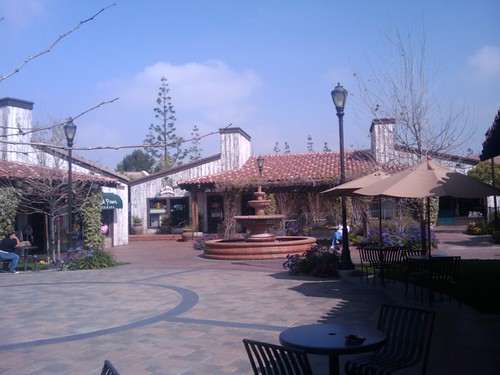
The centre of this neighbourhood is the Canyon Crest Towne Centre, a pleasant upscale shopping centre within walking distance of anywhere in that blue region above. This complex is more useful to daily urban life than most upscale suburban shopping centres- aside from the usual expensive restaurants and shops, there is a Ralph's grocery store and a 24-hour Rite Aid. There are also quite a few inexpensive dining options, both local shops and franchises. There is also a "contract postal unit"- a counter at the back of a Hallmark store that offers US Postal services- as well as a barber shop, a donut shop, a dry cleaning concern, an ice cream and drinking water store and a UPS store. Oh, and did I mention the local bike shop? Many of the restaurants are also quite tasty- our personal favourites include Romano's (not to be confused with the franchise Macaroni Grill), Smokey Canyon BBQ and the Tortilla Grille.
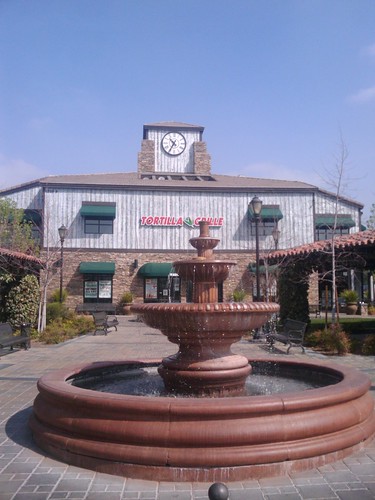
As you can tell from the photos, this is no ordinary suburban strip mall. Fountains, benches and attractive landscaping create a pleasant environment for walking and shopping. Piped-in music always annoys me, but apparently no walkable place in the suburbs can be without it. Having this shopping centre within walking distance has made my life immeasurably simpler, as almost anything one needs in daily life is on offer here- and often on offer 20 or 24 hours daily.
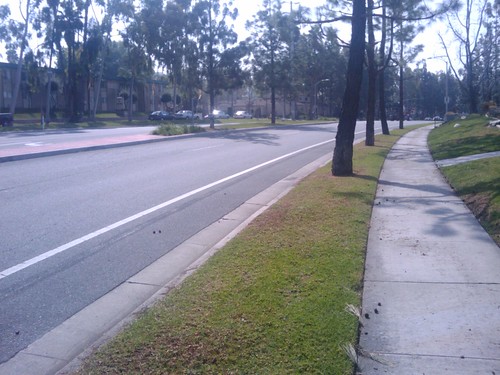
Beyond local shopping, the neighbourhood has a lot more to offer urbanist activists. Both major arterials through the area have bike lanes, and every street I've yet seen has well-maintained sidewalks on both sides.
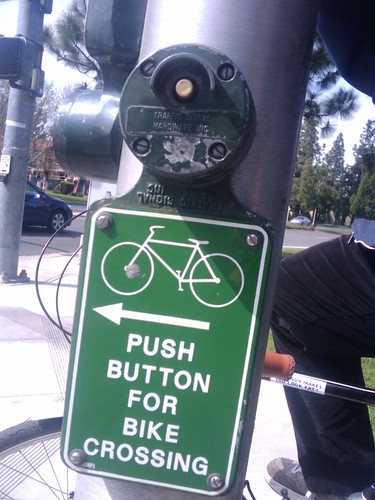
Bike lanes, specifically, are not in the door zone (as parking is prohibited on arterial roads), and many stoplights in the area have these convenient bicycle buttons on them. Off the arterials, neighbourhood roads are small and twisty, limiting speeds and making for pleasant cycling and walking. Crosswalks are well-striped and generally respected.
There are two parks in the area, the Sycamore Canyon Wilderness Park and Andulka Park. The former is a large expanse of land left to run wild, criss-crossed with trails that, I'm told, make for "world-class" mountain biking. The latter is a more traditional city park, with gazebos, picnic facilities, two children's playground, several ball fields, volleyball courts, a professional-grade tennis centre and even a small water play area for the kids in the summer. Sycamore Canyon is within easy walking distance of the Towne Centre, while Andulka is about a mile down an unpleasantly long hill.
Transit in the area is frequent and plentiful, at least by Riverside standards. Two routes serve the area during the day- routes 16 and 51. The 16 runs on a half-hourly schedule and provides a direct connection to the Moreno Valley Mall and associated shopping (along with transfers to Moreno Valley bus routes), UC Riverside, the downtown Metrolink station and downtown bus terminal (with transfers throughout the city). The 51 is a circulator shuttle that provides students access to the University and surrounding neighbourhood, though this includes many restaurants and the main post office. At night, the 51 is replaced by the 53, serving many of the same areas until half past midnight. My bus stop often sees 20 hours/day of transit service.
What's Wrong:
First off, the neighbourhood is somewhat lacking in true public space. The Towne Centre provides attractive plazas and seating, but it is a private shopping centre. I've never seen anyone kicked out for loitering, but the prominently-posted rule signs and overimportant security guards don't make for a welcoming atmosphere. The two public parks in the area are great, but one is truly wilderness and the other is in a very inconvenient location. Several locations would make for truly excellent pocket parks, but they have yet to be exploited.
Also, while the Towne Centre is definitely designed to provide a pleasant pedestrian experience, it (ironically, but in a tragically suburban fashion) only provides that experience for those who arrive by automobile. Take a look at this entrance:
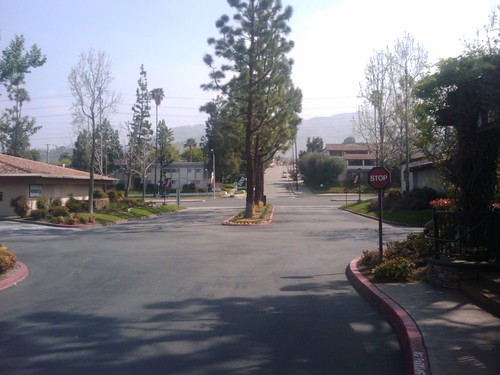
You'll notice the provision of high-speed automobile entrance and egress, and nothing else. And no, this isn't unique- most of the other entrances to the shopping centre are about the same. There are a couple of staircases for pedestrians, but they simply dump you out in the parking lot with all the other patrons. Pedestrian experience is treated here as something of a tourist attraction, something you drive to and enjoy.
The transit options in the area are definitely better than most in the suburbs, but they also vary significantly based on the season. The 51 and 53 only run during UCR academic days, and the 53 doesn't run on Fridays either. So that 20 hours of transit service? Only on UCR academic days that aren't Fridays. Granted, that's probably more often than not, but on other days there's just the 16, which shuts down at 9 normally, 8 on Saturdays and a pathetic 7:15 on Sundays (since the most recent service cuts). Also, half-hourly service is good for RTA (only one route in the system is more frequent), but verging on unpleasant anywhere else.
Last, though, driving is just too easy here. This area has easy freeway access from either wide, high-speed arterial. Traffic is almost unheard of, and most apartments come with two parking spaces per unit (and get poor ratings on ApartmentRatings if they don't). While the arterials don't, by and large, have on-street parking, neighbourhood streets most certainly do- free and unrestricted by the City's resident permit system. The Towne Centre has a vast parking lot, free to all comers, but little bicycle parking (despite my protests). Both parks have ample free parking, but only Andulka has any bicycle facilities- despite the "world-class" mountain biking. I speculated last year that this was why few people walk and bicycle even in a place that is relatively pedestrian- and bike-friendly.
What needs to be done:
Well, we need to fix what's wrong, obviously. Traffic calming on the major thoroughfares could improve things a bit, as could a reduction in the City's parking requirements for the Towne Centre. (I'm sure the owners wouldn't mind putting in more retail space.) Unbundling parking from housing prices, as well as trying to get some properties in on a universal transit pass, would help raise transit ridership. Getting actually decent transit wouldn't hurt, either- and the 16 Rapid should help with that, if it ever starts running. Neighbourhood pocket parks along the median between Canyon Crest and its frontage road would provide much-needed public space, especially if the street were traffic-calmed. Also, stationing a car-share car or two at the Towne Centre might convince some cash-strapped grad students that they can get by without their own.
So there you have it- my neighbourhood, what I think is the best place in the IE to call home. Stay tuned for further installments demonstrating why Riverside is worth saving.
Introduction:
View Riverside: Worth Saving in a larger map
The blue shape on the map above is roughly what I'm thinking about when I talk about my neighbourhood. Locals will notice that this differs quite a bit from the official City of Riverside boundaries of the Canyon Crest neighbourhood. That's because, outside of this walkable bit, much of Canyon Crest is unrepentant suburban cul-de-sac hell. Even many single-family homes near the shopping centre have streets laid out in such a way as to make walking from them to the shopping centre difficult, as you can see on the map. Also, what may be unclear on the map but is abundantly clear to anyone on foot is that this area is in Riverside's foothills. While the apartments are generally relatively close in elevation to the shopping centre, most of the single-family housing is built up or down any of a number of hills, somewhat discouraging leisurely strolls.
What's Right:
The centre of this neighbourhood is the Canyon Crest Towne Centre, a pleasant upscale shopping centre within walking distance of anywhere in that blue region above. This complex is more useful to daily urban life than most upscale suburban shopping centres- aside from the usual expensive restaurants and shops, there is a Ralph's grocery store and a 24-hour Rite Aid. There are also quite a few inexpensive dining options, both local shops and franchises. There is also a "contract postal unit"- a counter at the back of a Hallmark store that offers US Postal services- as well as a barber shop, a donut shop, a dry cleaning concern, an ice cream and drinking water store and a UPS store. Oh, and did I mention the local bike shop? Many of the restaurants are also quite tasty- our personal favourites include Romano's (not to be confused with the franchise Macaroni Grill), Smokey Canyon BBQ and the Tortilla Grille.
As you can tell from the photos, this is no ordinary suburban strip mall. Fountains, benches and attractive landscaping create a pleasant environment for walking and shopping. Piped-in music always annoys me, but apparently no walkable place in the suburbs can be without it. Having this shopping centre within walking distance has made my life immeasurably simpler, as almost anything one needs in daily life is on offer here- and often on offer 20 or 24 hours daily.
Beyond local shopping, the neighbourhood has a lot more to offer urbanist activists. Both major arterials through the area have bike lanes, and every street I've yet seen has well-maintained sidewalks on both sides.
Bike lanes, specifically, are not in the door zone (as parking is prohibited on arterial roads), and many stoplights in the area have these convenient bicycle buttons on them. Off the arterials, neighbourhood roads are small and twisty, limiting speeds and making for pleasant cycling and walking. Crosswalks are well-striped and generally respected.
There are two parks in the area, the Sycamore Canyon Wilderness Park and Andulka Park. The former is a large expanse of land left to run wild, criss-crossed with trails that, I'm told, make for "world-class" mountain biking. The latter is a more traditional city park, with gazebos, picnic facilities, two children's playground, several ball fields, volleyball courts, a professional-grade tennis centre and even a small water play area for the kids in the summer. Sycamore Canyon is within easy walking distance of the Towne Centre, while Andulka is about a mile down an unpleasantly long hill.
Transit in the area is frequent and plentiful, at least by Riverside standards. Two routes serve the area during the day- routes 16 and 51. The 16 runs on a half-hourly schedule and provides a direct connection to the Moreno Valley Mall and associated shopping (along with transfers to Moreno Valley bus routes), UC Riverside, the downtown Metrolink station and downtown bus terminal (with transfers throughout the city). The 51 is a circulator shuttle that provides students access to the University and surrounding neighbourhood, though this includes many restaurants and the main post office. At night, the 51 is replaced by the 53, serving many of the same areas until half past midnight. My bus stop often sees 20 hours/day of transit service.
What's Wrong:
First off, the neighbourhood is somewhat lacking in true public space. The Towne Centre provides attractive plazas and seating, but it is a private shopping centre. I've never seen anyone kicked out for loitering, but the prominently-posted rule signs and overimportant security guards don't make for a welcoming atmosphere. The two public parks in the area are great, but one is truly wilderness and the other is in a very inconvenient location. Several locations would make for truly excellent pocket parks, but they have yet to be exploited.
Also, while the Towne Centre is definitely designed to provide a pleasant pedestrian experience, it (ironically, but in a tragically suburban fashion) only provides that experience for those who arrive by automobile. Take a look at this entrance:
You'll notice the provision of high-speed automobile entrance and egress, and nothing else. And no, this isn't unique- most of the other entrances to the shopping centre are about the same. There are a couple of staircases for pedestrians, but they simply dump you out in the parking lot with all the other patrons. Pedestrian experience is treated here as something of a tourist attraction, something you drive to and enjoy.
The transit options in the area are definitely better than most in the suburbs, but they also vary significantly based on the season. The 51 and 53 only run during UCR academic days, and the 53 doesn't run on Fridays either. So that 20 hours of transit service? Only on UCR academic days that aren't Fridays. Granted, that's probably more often than not, but on other days there's just the 16, which shuts down at 9 normally, 8 on Saturdays and a pathetic 7:15 on Sundays (since the most recent service cuts). Also, half-hourly service is good for RTA (only one route in the system is more frequent), but verging on unpleasant anywhere else.
Last, though, driving is just too easy here. This area has easy freeway access from either wide, high-speed arterial. Traffic is almost unheard of, and most apartments come with two parking spaces per unit (and get poor ratings on ApartmentRatings if they don't). While the arterials don't, by and large, have on-street parking, neighbourhood streets most certainly do- free and unrestricted by the City's resident permit system. The Towne Centre has a vast parking lot, free to all comers, but little bicycle parking (despite my protests). Both parks have ample free parking, but only Andulka has any bicycle facilities- despite the "world-class" mountain biking. I speculated last year that this was why few people walk and bicycle even in a place that is relatively pedestrian- and bike-friendly.
What needs to be done:
Well, we need to fix what's wrong, obviously. Traffic calming on the major thoroughfares could improve things a bit, as could a reduction in the City's parking requirements for the Towne Centre. (I'm sure the owners wouldn't mind putting in more retail space.) Unbundling parking from housing prices, as well as trying to get some properties in on a universal transit pass, would help raise transit ridership. Getting actually decent transit wouldn't hurt, either- and the 16 Rapid should help with that, if it ever starts running. Neighbourhood pocket parks along the median between Canyon Crest and its frontage road would provide much-needed public space, especially if the street were traffic-calmed. Also, stationing a car-share car or two at the Towne Centre might convince some cash-strapped grad students that they can get by without their own.
So there you have it- my neighbourhood, what I think is the best place in the IE to call home. Stay tuned for further installments demonstrating why Riverside is worth saving.
Subscribe to:
Posts (Atom)

