Happy Halloween, everyone!
Local events in red, HSRA events in orange.
If you find this feature useful, please don't hesitate to subscribe to either of these calendars.

Sunday, October 31, 2010


Friday, October 29, 2010
Service Changes
Nothing earth-shattering here, but the January 2011 service changes were approved by the Board yesterday. There have been no severe cuts, but a couple of routes will lose underperforming school tripper services. A few routes will see routing changes, mostly in Hemet/San Jacinto in order to serve a few new destinations.
Check out the details here.
Check out the details here.
Thursday, October 28, 2010
Vegas Travelogue, Part 3: Vegas Transit
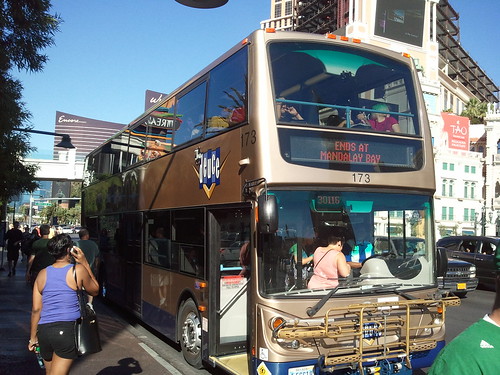
(You can also catch parts 1 and 2 of my Vegas travelogue, which mostly consist of me griping about traffic.)
Las Vegas is a strange, libertarian fantasyland. Everything on the Strip gleams in bright, shining neon and marble, with clean, well-maintained sidewalks, roads and bridges. Get a block away and the sidewalks are cracked, the streets lined with vacant lots and run-down apartments. The power relationships of the city are written right there on its urban form. But, interestingly enough, the region has a pretty extensive transit system. Because of the significant demand of drunken tourists and low-wage hospitality workers, the all-bus system runs frequently, all day and every day.
It also has the unique characteristic of charging more for visitors than locals, at least along the Strip. The two Strip services, the ACE Gold Line and the Deuce (express and local, respectively), charge a higher fare for out-of-town visitors than they do for Clark County residents.
Anyway, down to the nitty-gritty. The Strip has two services that run along it- the Deuce (local) is a set of double-decker buses (pictured above) that run every 10-20 minutes, 24 hours a day. The ACE Gold Line is a new bus rapid transit system that links downtown Las Vegas with the Strip and the McCarran Airport. Both services share stops and ticket vending machines along the Strip.
Off the strip, the RTC system is mostly a grid-based system, with a sensible numbering system. 100-series routes run mostly north-south, with numbering starting with 101 in the west and moving up as the routes serve further eastward streets. 200-series routes run mostly east-west, starting at 201, with higher numbers moving northwards. Many trunk line routes run at 10-15 minute frequencies, and much of the system is 24 hours a day, 7 days a week.
So how well does this all work? We stuck around our hotel on Tropicana, a block over from the Strip, and on the Strip itself most of the time. Travelling northbound on the Strip, and off the Strip, was fantastic. Travelling southbound, which we always seemed to do at rush hour, was a nightmare. There was construction at the Bellagio, cutting off just one lane of the 8 lane Strip- and it made traffic a festering hellhole of despair. Furthermore, the stop at the Bellagio was meant to be a stop both for the Deuce and ACE lines, but the ACE line passed us up several times with no more than a fare-thee-well. It seems that the stop was too short for the articulated ACE buses, but no notification to that effect was posted.
The ACE Gold Line buses, however, weren't immune to these horrible traffic maladies. It seems to me that what the Strip really needs is bus lanes. North of the Strip, the ACE runs in a centre-median busway, separated from traffic. In the most traffic-choked parts of the city, though, the bus lanes disappear when they are most needed.
Beyond the transit troubles caused by the construction, it occurred to me that never before have I seen so very many people walking in such a terribly bad pedestrian environment. You see, most intersections on the Strip lack crosswalks, or only have them on one side. There are these pedestrian bridges at most major streets. The trouble with transit in the area, though, is that the grid system necessitates transferring between stops on different corners of the street. Even when they're on the same side of the street, it can be a quarter-mile walk between them. The fact that people nevertheless walk and use transit is an impressive statement of the willingness of people to avoid their automobiles while on vacation, or to the poverty and desperation of hospitality workers in Las Vegas.
Sunday, October 24, 2010
This Week in Transit, 10/24
Local events in red, HSRA events in orange.
If you find this feature useful, please don't hesitate to subscribe to either of these calendars.
If you find this feature useful, please don't hesitate to subscribe to either of these calendars.
Wednesday, October 20, 2010
November Election Endorsements
If you're even marginally politically active, you may have noticed that we have an election coming up. Remember to get out and vote on Tuesday, November 2nd, or at any Early Voting centre throughout the county.
With that in mind, here are my endorsements for the upcoming election:
For statewide issues, I can't do better than the endorsements from the excellent progressive blog Calitics. They recommend voting a straight Democratic ticket- normally I'm not so loyal a Democrat (I'm a registered Green), but in this election the alternative is conservative domination. That'd be bad, so I'm joining the Calitics gang in this one.
For local races:
Congress, 44th District: Bill Hedrick
Bill is a real progressive, the kind of person we need in Washington. His policies on transportation and land use are currently unknown; but we do know that, while he's opposed to wasteful spending, he's not going to vote to turn the tap off entirely while so many constituents are hurting (like our current representative did, repeatedly). Also, getting a Democrat elected in this seat reduces the likelihood of Speaker Boehner presiding over the next federal transportation bill.
(County of Riverside)
Auditor: No endorsement.
Both candidates for county auditor, Mr. Chand and Mr. Angulo, are beating the fiscal responsibility drums as loudly and as often as possible. That's the last thing we need right now. If you're in the mood for it, write me in. That's Alethea J. Nelson. That's what I did.
Measure L: YES
Measure M: NO
Measure L would require voters to approve any changes in public safety pension benefits. While I'm normally opposed to ballot-box budgeting, local governments are looking for nearly any way to cut spending without raising taxes these days, including raiding the pension benefits of our police and firefighters. The people who risk their lives to protect society every day should be entitled to the pensions they've been promised. Measure M would require voter approval to raise pensions, but allow the County to unilaterally lower them. Its passage would be a disgrace, and a breach of contract with those who have spent their lives protecting us.
Measure K: YES
Measure K will allow RCTC to borrow more money in order to take advantage of current low construction costs for road and rail projects throughout the county. This vote is a sort of Faustian bargain, because it will mean accelerated freeway widening for CA-91 and other roads, but it will also ensure the timely completion of the long-suffering Perris Valley Line Metrolink extension. Furthermore, the only way we get out of this budget crisis is by putting people back to work, and even road-building does that.
(City of Riverside)
Measure V: YES
I reported some time ago that Riverside was enjoying a surplus thanks to sensible spending and reasonable taxation and borrowing. (A lot of it went to build more parking. Yay.) Well, to continue the prosperity that the City has been enjoying, voters have been asked to raise taxes on hotel guests by 2%, from 11% to 13%. The funds will be spent on City services and possibly the new Convention Centre downtown, which promises to be sensibly integrated into a mixed-use environment. (Anything is better than the current structure surrounded by acres of surface parking.)
Above all though, it's critical that you get out and vote on Tuesday, November 2nd or at any early voting centre. You might also want to consider, in future elections, becoming a "permanent absentee" voter- your ballot comes by mail, and you return it either by mail, at several drop-off points around the county, or at any precinct on Election Day. It's quick, convenient, and helps ensure that your voice is hear. I vote by mail every year, and spend my Election Day volunteering for causes I care about.
With that in mind, here are my endorsements for the upcoming election:
For statewide issues, I can't do better than the endorsements from the excellent progressive blog Calitics. They recommend voting a straight Democratic ticket- normally I'm not so loyal a Democrat (I'm a registered Green), but in this election the alternative is conservative domination. That'd be bad, so I'm joining the Calitics gang in this one.
For local races:
Congress, 44th District: Bill Hedrick
Bill is a real progressive, the kind of person we need in Washington. His policies on transportation and land use are currently unknown; but we do know that, while he's opposed to wasteful spending, he's not going to vote to turn the tap off entirely while so many constituents are hurting (like our current representative did, repeatedly). Also, getting a Democrat elected in this seat reduces the likelihood of Speaker Boehner presiding over the next federal transportation bill.
(County of Riverside)
Auditor: No endorsement.
Both candidates for county auditor, Mr. Chand and Mr. Angulo, are beating the fiscal responsibility drums as loudly and as often as possible. That's the last thing we need right now. If you're in the mood for it, write me in. That's Alethea J. Nelson. That's what I did.
Measure L: YES
Measure M: NO
Measure L would require voters to approve any changes in public safety pension benefits. While I'm normally opposed to ballot-box budgeting, local governments are looking for nearly any way to cut spending without raising taxes these days, including raiding the pension benefits of our police and firefighters. The people who risk their lives to protect society every day should be entitled to the pensions they've been promised. Measure M would require voter approval to raise pensions, but allow the County to unilaterally lower them. Its passage would be a disgrace, and a breach of contract with those who have spent their lives protecting us.
Measure K: YES
Measure K will allow RCTC to borrow more money in order to take advantage of current low construction costs for road and rail projects throughout the county. This vote is a sort of Faustian bargain, because it will mean accelerated freeway widening for CA-91 and other roads, but it will also ensure the timely completion of the long-suffering Perris Valley Line Metrolink extension. Furthermore, the only way we get out of this budget crisis is by putting people back to work, and even road-building does that.
(City of Riverside)
Measure V: YES
I reported some time ago that Riverside was enjoying a surplus thanks to sensible spending and reasonable taxation and borrowing. (A lot of it went to build more parking. Yay.) Well, to continue the prosperity that the City has been enjoying, voters have been asked to raise taxes on hotel guests by 2%, from 11% to 13%. The funds will be spent on City services and possibly the new Convention Centre downtown, which promises to be sensibly integrated into a mixed-use environment. (Anything is better than the current structure surrounded by acres of surface parking.)
Above all though, it's critical that you get out and vote on Tuesday, November 2nd or at any early voting centre. You might also want to consider, in future elections, becoming a "permanent absentee" voter- your ballot comes by mail, and you return it either by mail, at several drop-off points around the county, or at any precinct on Election Day. It's quick, convenient, and helps ensure that your voice is hear. I vote by mail every year, and spend my Election Day volunteering for causes I care about.
Vegas Travelogue, Part 2
I mentioned in the first part of my travelogue that there's no good way to get to Vegas. Today, I'll go over what happens when you take the bad way to Vegas- private automobile on I-15. On the way out there, I picked up my wife at the school where she works (in Magnolia Centre) at 3:00. By the time we hit the CA-91, traffic was already stop-and-go. From Central Ave. to the split with CA-30 (approximately 14 miles and an agonizing half an hour), we were lucky to crawl along at a speed which caused our speedometer to register. After that point, we were largely in the clear until entering Las Vegas itself, where local traffic at the I-15/NV-215 interchange caused some slowing. Of course, the entire drive was characterized by that unique combination of interminable boredom and constant vigilance that marks any long-distance road trip, and it was 4 and a half hours in which I could have been making valuable progress on course readings but was instead staring at asphalt ribbons across salt flats.
I should note that this sort of traffic pattern is particularly problematic for the DesertXPress HSR plan- attentive readers will note that the first phase of the project is planned to terminate in lovely Victorville, CA, notably past the point where we encountered traffic. Angelenos that have to work until 5pm will find the drive across the LA basin to I-15 even more problematic than us IE types, especially since we left at 3pm. Unless DesertXPress is connected to some form of transit infrastructure, it will offer only minimal traffic relief for many. (I can envision a future in which the HSR is fed by both a giant parking garage and San Joaquin-style bus connections to points around the LA metro region, until the Victorville-Palmdale-LAUS connection is constructed. That might work out.)
On the way home, traffic was something other than smooth sailing. From just past the urbanized area of Las Vegas all the way to Primm (the state line), traffic was at a virtual stand-still. It took us over two hours to traverse 25 miles- I quite literally could have biked it faster. Worst of all, there was no discernible reason for the congestion- the road was littered with "Road Work" signs, but we never saw a single road worker, let alone anything that could be described as "working." There was also no evidence of a traffic collision- if such a crash occurred, it did so long before we went through. Because of the sheer volume of traffic on the route, and the lack of alternate routes, traffic conditions remained poor throughout the drive, and there would be random stoppages every so often along the way. The California Agricultural Inspection checkpoint- normally a 5 minute nuisance- took more than half an hour to clear. What was a 4:30 drive on the way out was nearly 8 hours on the return trip. That sort of unpredictability is an inherent problem of an automobile system that is over capacity, and one that desperately screams for alternatives. We need some other way to get out to Vegas. We need to create a class of people who no longer have to care about traffic congestion- and for that, we need an exclusive transitway of some kind, either busway or rail. And we need it yesterday.
In the next instalment, I'll cover my experiences with transit in Las Vegas itself.
I should note that this sort of traffic pattern is particularly problematic for the DesertXPress HSR plan- attentive readers will note that the first phase of the project is planned to terminate in lovely Victorville, CA, notably past the point where we encountered traffic. Angelenos that have to work until 5pm will find the drive across the LA basin to I-15 even more problematic than us IE types, especially since we left at 3pm. Unless DesertXPress is connected to some form of transit infrastructure, it will offer only minimal traffic relief for many. (I can envision a future in which the HSR is fed by both a giant parking garage and San Joaquin-style bus connections to points around the LA metro region, until the Victorville-Palmdale-LAUS connection is constructed. That might work out.)
On the way home, traffic was something other than smooth sailing. From just past the urbanized area of Las Vegas all the way to Primm (the state line), traffic was at a virtual stand-still. It took us over two hours to traverse 25 miles- I quite literally could have biked it faster. Worst of all, there was no discernible reason for the congestion- the road was littered with "Road Work" signs, but we never saw a single road worker, let alone anything that could be described as "working." There was also no evidence of a traffic collision- if such a crash occurred, it did so long before we went through. Because of the sheer volume of traffic on the route, and the lack of alternate routes, traffic conditions remained poor throughout the drive, and there would be random stoppages every so often along the way. The California Agricultural Inspection checkpoint- normally a 5 minute nuisance- took more than half an hour to clear. What was a 4:30 drive on the way out was nearly 8 hours on the return trip. That sort of unpredictability is an inherent problem of an automobile system that is over capacity, and one that desperately screams for alternatives. We need some other way to get out to Vegas. We need to create a class of people who no longer have to care about traffic congestion- and for that, we need an exclusive transitway of some kind, either busway or rail. And we need it yesterday.
In the next instalment, I'll cover my experiences with transit in Las Vegas itself.
Friday, October 15, 2010
Bicycle Advisory News Dump
Last night was the City of Riverside's Bicycle Advisory Committee meeting. The BAC is a great organization that acts as the voice of the cycling community in the City's Public Works department. Aside from the advocacy that happens there, the committee is also a great source for cycling news in and around the city, and that's the reason for this post. Here's what's happening in Riverside on two wheels.
Santa Ana River Trail Closures
At an indeterminate date in the near future, the Santa Ana River Trail will be torn up so that crews can replace the 100-year-old sewer pipe that runs below it. The trail will be entirely closed on weekdays, and will be "rideable, but not nice and pretty" on weekends. The sewer replacement project will occur in two phases, each covering about half of the trail's mileage in the City and taking 4-6 months each. The first phase will cover from Van Buren Blvd to Rubidoux Ave (about a mile north of Martha Mclean Park). The Santa Ana Watershed Project Authority's web site should have construction updates in the near future.
Bike Parking Soon Mandatory
City officials note that the new California Green Code will mandate bicycle parking for both visitors and employees at essentially all new development in the state, beginning on January 1st, 2011. Some details of interpretation are still under discussion, but it looks like bicycle parking will need to be provided at a rate of 5% of automobile parking, with a minimum of 1 2-bike rack per business. I'll post more as I learn more.
Riverside Citrus Classic
Though "Classic" is probably not the best word to use for a bike ride that is happening for the first time ever this year, the Riverside Citrus Classic will run this Sunday. Riders may choose from a Century, Half-Century, Quarter-Century, or 7-mile Family Ride, all of which start and end at the Riverside Plaza. Registration is still open online, but not for much longer. Proceeds benefit local schools.
A Bike Collective for Riverside
Cities across the country with strong bicycle cultures support "community bicycle organizations" or "bike collectives"- places staffed by volunteer mechanics that provide tools, workspace and know-how to people who want to fix their own bikes, usually for free or a small fee. My readers may be familiar with the Times Up! in New York, or LA's trifecta of the Bike Kitchen, Bike Oven and Bikerowave. San Francisco, Sacramento and Davis all boast bike collectives of their own. Most of my readers would join me in thinking that Riverside could not support such an organization.
We'd be wrong. The Bicycle Lounge has apparently been operating at the First Thursday Art Walks for the last two years, and is now moving in to more permanent spaces. First, they'll be at the UCR-Culver Centre for the Arts from 12-4 every Saturday through December, starting tomorrow. Second, their web site says they'll be opening a location on campus at UCR in the near future. Stop by and learn to maintain and repair your bicycle. There is something uniquely satisfying about knowing that you can repair your own vehicle when it breaks, and most of us will never get that with a car. A bike, however, is simple enough that you CAN learn to fix nearly everything on it.
Culver Centre Bike Exhibit
The newly-opened UCR-Culver Centre for the Arts is running, as their first-ever exhibit, "Re:Cycle- Bicycle Culture in Southern California." Artists explore both local bicycle culture and what the bicycle means to the human experience. Local bicycle advocates will recognize a lot of what's going on, especially with the section devoted to the Midnight Ridazz. Also, tomorrow they'll be screening "The Bicycle Thief" and "To Live And Ride in LA" back-to-back. Admission to the screening is $10 for adults, and advance reservations are recommended. Admission to the exhibition appears to be free, but visitors would be well-served by taking along either UCR ID cards or a nominal amount of cash, just to be safe.
Santa Ana River Trail Closures
At an indeterminate date in the near future, the Santa Ana River Trail will be torn up so that crews can replace the 100-year-old sewer pipe that runs below it. The trail will be entirely closed on weekdays, and will be "rideable, but not nice and pretty" on weekends. The sewer replacement project will occur in two phases, each covering about half of the trail's mileage in the City and taking 4-6 months each. The first phase will cover from Van Buren Blvd to Rubidoux Ave (about a mile north of Martha Mclean Park). The Santa Ana Watershed Project Authority's web site should have construction updates in the near future.
Bike Parking Soon Mandatory
City officials note that the new California Green Code will mandate bicycle parking for both visitors and employees at essentially all new development in the state, beginning on January 1st, 2011. Some details of interpretation are still under discussion, but it looks like bicycle parking will need to be provided at a rate of 5% of automobile parking, with a minimum of 1 2-bike rack per business. I'll post more as I learn more.
Riverside Citrus Classic
Though "Classic" is probably not the best word to use for a bike ride that is happening for the first time ever this year, the Riverside Citrus Classic will run this Sunday. Riders may choose from a Century, Half-Century, Quarter-Century, or 7-mile Family Ride, all of which start and end at the Riverside Plaza. Registration is still open online, but not for much longer. Proceeds benefit local schools.
A Bike Collective for Riverside
Cities across the country with strong bicycle cultures support "community bicycle organizations" or "bike collectives"- places staffed by volunteer mechanics that provide tools, workspace and know-how to people who want to fix their own bikes, usually for free or a small fee. My readers may be familiar with the Times Up! in New York, or LA's trifecta of the Bike Kitchen, Bike Oven and Bikerowave. San Francisco, Sacramento and Davis all boast bike collectives of their own. Most of my readers would join me in thinking that Riverside could not support such an organization.
We'd be wrong. The Bicycle Lounge has apparently been operating at the First Thursday Art Walks for the last two years, and is now moving in to more permanent spaces. First, they'll be at the UCR-Culver Centre for the Arts from 12-4 every Saturday through December, starting tomorrow. Second, their web site says they'll be opening a location on campus at UCR in the near future. Stop by and learn to maintain and repair your bicycle. There is something uniquely satisfying about knowing that you can repair your own vehicle when it breaks, and most of us will never get that with a car. A bike, however, is simple enough that you CAN learn to fix nearly everything on it.
Culver Centre Bike Exhibit
The newly-opened UCR-Culver Centre for the Arts is running, as their first-ever exhibit, "Re:Cycle- Bicycle Culture in Southern California." Artists explore both local bicycle culture and what the bicycle means to the human experience. Local bicycle advocates will recognize a lot of what's going on, especially with the section devoted to the Midnight Ridazz. Also, tomorrow they'll be screening "The Bicycle Thief" and "To Live And Ride in LA" back-to-back. Admission to the screening is $10 for adults, and advance reservations are recommended. Admission to the exhibition appears to be free, but visitors would be well-served by taking along either UCR ID cards or a nominal amount of cash, just to be safe.
Subscribe to:
Posts (Atom)

