Showing posts with label ucr. Show all posts

Friday, January 16, 2015

Riverside's First Two-Way Bike Lane

It's not quite a cycletrack, because it's not protected along most of its length, and it's only a block long, but it's a pretty major improvement in the cycling infrastructure around UCR. It's Riverside's first two-way on-street bike lane!
It runs from the Bannockburn Apartments on Canyon Crest to here, the intersection of Campus Drive and University:

Except that, as you'll notice from the directional arrows there, it doesn't quite do that. The lane is designed to funnel cyclists headed southbound on Canyon Crest into the UCR campus, and so the contraflow lane ends at a point where the lane intersects a major campus walkway:
I should be clear, I like this facility. I ride it almost every day. I think the concrete curb protecting cyclists is awesome and long-overdue, especially since it prevents the (illegal) passenger loading operations that regularly blocked the bike lane and walkway portal at this corner. That said, I think that there are major problems on both ends of the lane.

The lane starts basically mid-block on Canyon Crest, at the north end of the stoplight at Bannockburn's driveway. I cannot see any way for cyclists to legally and safely transition between riding in the traditional, southbound with-traffic lane on the west side of Canyon Crest to entering the contraflow lane. The only thought I could come up with is that cyclists are supposed to dismount, use the crosswalk at Bannockburn, and mount up again to enter the new lanes on the east side of the street.

What actually ends up happening in practice is this:

Cyclists either simply ride the wrong way down the existing northbound bike lane, or they cross the street somewhere in the middle and ride in oncoming traffic to get to the new lanes.

Something similar happens on the Campus Drive section of the bike lane, with cyclists from campus ignoring the fact that the lane is one-way (eastbound) at that point, and proceeding westbound behind the new curb and all the way down to the University Village.

Granted, both of these maneuvers were happening long before this facility went in. In putting in the contraflow lane, the City painted what cyclists were doing anyway. But I fail to understand why the lane was stopped at Bannockburn, rather than extended at least to Linden St., or ideally to Blaine St. That way, cyclists could enter the lanes when they turned on to Canyon Crest, and they would be able to ride legally and safely the entire length of the street. To my (admittedly untrained) eye, the street width looks pretty constant from UCR all the way to Blaine St.

Furthermore, I strongly advocated for the extension of this facility down University to the University Village. The City could have removed the existing westbound lane, shifted the whole street over, and added that lane back in on the south side of University. I even rode with Charlie Gandy to outline such an option, back when he was working with the City. As-is, I have to dodge several salmoning cyclists (and worse, scooter-riders and skateboarders) every time I ride from the UV up towards campus. The new cycletrack only encourages this behavior.

Lastly, there is one major safety issue with the lane-- the lack of bollards on the Campus Dr. side. Cars are used to turning right around that corner, and some still do so, only to find themselves on the wrong side of the concrete barrier. Once a car is in the lane, there is no way for them to leave but to drive through it, which many do in a panicked hurry. I myself nearly got run over by a Jeep Cherokee in the lane while taking the pictures for this article.

So, in summary, Riverside now has a two-way on-street bike lane. It is flawed, but it is a step in the right direction. We need to keep the pressure up on the City so that they extend this facility to its rightful conclusions on both ends.

Tuesday, July 3, 2012

CSUSB Loses Transit Passes

As of last Saturday, June 30th, the one-year pilot program to provide Cal State San Bernardino students with universal transit passes has expired. Apparently, no permanent program was organized to replace it. This sucks, because universal transit passes are an extremely effective tool to promote transit ridership.

First off, they eliminate one of the several impediments to new riders trying transit: understanding fare policy. Fare policy can be complicated, as this old post I wrote about transfers demonstrates. Beyond that, there are local/express distinctions within the RTA system. Some other transit agencies further confuse the issue with zone fare systems, peak/off-peak distinctions, distance fares, bike rack permits, the list goes on. And don't get me started on the miserable failure that was the fare policy on the old 149 (now 216). "Just swipe/flash your card and go" gets rid of all that, and the corresponding anxiety for first-time riders.

Second, they offer all the benefits that a transit pass usually offers, combined with the fact that it's on a card that most college students carry anyway. It's easy for me to go out to lunch with colleagues on the bus, even if they're not usually bus riders, because they've all got UCR ID cards in their wallets.

Last, and this is especially true for college passes, is that universal transit passes develop habits in young adults that may stick with them for life. My generation is one that was raised overwhelmingly in the suburbs. Many friends, colleagues, and students have never ridden a public bus in their lives until their arrival at college. (This is especially true at UCR.) Introducing students to public transit just might get them hooked, and they're more likely to try it if you make it free.

So, Cal State folks, I wish you the best in getting a universal transit pass restored to your campus.

Tuesday, April 24, 2012

Bear Runner on its last legs

A little history here. Prior to my moving to Riverside (although I don't know when), UCR Transportation and Parking Services used to run a night-time-only Dial-a-Ride van on campus. It ran Monday-Thursday evenings, and would take students to any point on campus or to any off-campus apartments served by the then-operating Highlander Hauler system. (At the time, this included all of the apartments in the University and Canyon Crest areas.)

For the 2004-2005 school year, TAPS did something different- they introduced the Bear Runner late-night shuttle service. Providing half-hour service, it ran essentially the present Route 53 schedule and route, but it had one serious drawback-- the gentleman who drove it thought of his job as "taking students home from campus," and would only drive the route all the way around if he picked up somebody on campus, or if he knew somebody would be waiting. I've been stranded by that policy more than once.

Needless to say, when the RTA picked up the route and actually started *running* it, it was a substantial improvement. The half-hourly service is the only public transit service between Montclair and Las Vegas that runs past 10pm. During the school year, its presence gives my neighborhood 21-hour-a-day transit service. And so, of course, RTA is going to cancel it.

The route is, admittedly, only lightly-used-- but this isn't a service whose existence is ever justified based on ridership. It's always been funded by the campus primarily as a safety service, allowing students studying late at night to avoid walking home in the dark. Sadly, it appears that UCR no longer finds it "effective" at accomplishing that goal, and will be discontinuing the subsidy. With the subsidy, so goes the route.

I doubt that anything can be done to save the route-- it exists at the pleasure of UCR, and Parking Services is notoriously un-susceptible to influence. Still, I will mourn its loss, if only for freeing my social circle from having a designated driver while bar-hopping around campus. (It really should have run on Friday nights.)

If you'd like to rail ineffectively at RTA officials in an attempt to save the only late-night bus in Riverside, there are hearing details in this article.

Tuesday, April 3, 2012

Shiny new surprise!


Here's a nice surprise I found on my commute home: what I believe is Riverside's first green bike lane! It's in the southbound bike lane on Canyon Crest just before 14th, and extends across the auto path to the right-hand turn lane. I don't have any other details on the project, or whether similar facilities are planned elsewhere.

I do know that I'd really, really like to see this on the other side of this intersection though: northbound traffic on Canyon Crest travels a lot faster, and ignores bikes a lot more readily.

Tuesday, January 31, 2012

University Avenue ramp closure solves another problem

I wrote in my last post that, if we care about having a safe, walkable UC Riverside campus, we should close the University Avenue freeway ramps and allow drivers to divert to the 3rd/Blaine and 14th ramps, both of which are on high-speed arterial roadways and both of which are within half a mile of University. Minimal inconvenience for drivers would mean massive safety and quality-of-life benefits for the thousands of students on foot, skateboard, kick scooter, and bicycle who use that corridor.

But something it might also be able to solve is the lack of a centralized transit center at UC Riverside. It was more of a problem back in the days of the Highlander Hauler shuttles, but it's still an issue now: when you take the bus to "UCR," you could be stopping at any of a number of different places, and none of them are conducive to transfer. Most of them are single-route stops. Currently, the 1 stops at Bannockburn Village (on Canyon Crest just north of University); the 16 actually travels through campus on Campus Drive, stopping near Arts and Sproul Hall; the 204 stops near Bannockburn, but on the other side of the street; the 208, 210 and 212 all stop in the backwaters of Lot 30; and only the 51 and 53 link them all (but 51 only runs every 40 minutes, and 53 every 30 and only at night). Furthermore, the 10 and 14 both skirt the campus, but don't actually serve it, with 10 running along Blaine and 14 turning off University on to Iowa.

This fragmentation of routes makes transit use significantly more difficult and confusing than it should be at UCR. Students, many of whom have never ridden a city bus in their lives, see all of these various white buses moving in inscrutable patterns around campus, seeming to veer off in mysterious directions, and they get the perception that if you step aboard an RTA bus, you will have no idea where you're going. I have related many stories before on this blog of students who were traveling to the Canyon Crest Town Center area waiting longer for the "trolley" #51, rather than take the #16.

Fragmentation also reduces effective frequency, which is a serious issue for the short trips that many students make throughout the day. If I want to head down University to one of the various Chinese take-out places around Cranford or Chicago, it doesn't matter to me which route I take- the #1, #14 or #16 are all fine by me. However, there's no place on campus that I can actually wait for all of the above. If I want #1, I have to head to Bannockburn. If I want #16, I need to be in front of Sproul Hall. These places are around a ten minute walk apart. Personally, I use the Bus Tracker and Google Transit to figure out which route is leaving first, but students who have never ridden a bus won't figure this trick out easily-- and so they'll drive three blocks down the street.

Okay, so I've laid out the problem. What does this have to do with the University Avenue ramps?

Real estate.

One of the University ramps is a huge loop leading to and from the westbound freeway. Demolish this, and you'll have a nice parcel of land for a bus station, complete with space for bus layovers (which are a current problem at Bannockburn, where the #1 and #51 compete with the many, many beer delivery trucks that serve the Getaway Cafe). Such a station would be a destination strong enough to warrant the diversion of the #10 and #14 to campus (and give them space to turn around), and would provide a place for every route in the area to come together and provide extremely frequent service to nearby destinations. It's also equidistant between the University Village and the rest of campus, and there are already stoplights at the site (for the present freeway ramps). As long as the current stops on the #1 and #16 were maintained, it wouldn't downgrade anyone's present travel plans, and it would provide better access to both the university (for the community) and the wider community (for university students). It would also give public transit on campus a much more visible and permanent presence, and significantly improve the legibility of the various routes that currently almost-meet in and around the area. Done properly, you could also add automated ticketing facilities, SmartStop arrival boards, etc. that could really improve the transit experience for a whole population of users who, for the first time in their lives, find themselves without ready access to an automobile.

So, close the University Avenue ramps, tear them down, and build a UCR bus station in its place. Introduce a generation of students to urbanism the way it should be.

Monday, January 30, 2012

Radically simple solution: Close the University Ave. ramps

I spend a lot of time at UC Riverside. Those who are familiar with the campus know that it's bisected by the I-215/CA-60 freeway, with the campus on one side and most of the various retail establishments in the area on the other. Those who follow my blog know that one of the things that really irritates me, day in and day out, is the way that Caltrans "improved" University Avenue heading eastbound, by removing a bicycle lane from the most heavily bicycle-trafficked stretch of asphalt in the city. They did this to accommodate two right-hand turn lanes to a freeway offramp.

That's a tragedy in and of itself, and yet another example of the tiny crumbs given to bicycles taken away in order to move cars just a little bit faster, but the real tragedy is this: there are three ramps to this freeway within a one-mile stretch.


View Larger Map

Count them: three. One at Blaine/3rd, one at University, and one at 14th.

Let's take a look at these roads, shall we? 3rd through that section is pretty unpleasant for anyone not in a car, with low-density retail, a high school, crumbling sidewalks and disappearing bike lanes. (It gets better below Kansas or so, though...) The freeway overpass itself is pretty awful to walk or ride across. It's pretty much a car sewer. This is also the exit for one of UCR's larger remote parking lots, Lot 26. Above Iowa there are several student apartments, including many I've resided in, but I usually went down Linden if I had to cross the freeway without the aid of a motor vehicle.

14th is even worse. This road is wide, flat, and there is literally nothing of interest between Chicago and the freeway. There are research orange groves and UCR's massive Lot 30, primary parking lot for the entire campus. This road has a 55mph speed limit, and speeds often exceed that. Nothing redeeming here.

So finally we come to University. This is a thriving commercial corridor. There's plenty of parking, as you might expect in suburbia, but none of the huge student lots here. Most buildings front the street, at least between campus and Cranford. There are plentiful restaurants catering to the student population, along with a good chunk of retail establishments, and Riverside's only modern mixed-use development, Sterling University Palms. This is also a major transit corridor (#1, #14, #16, #51/53), unlike either 3rd (just the #10) or 14th (commuter express routes only). Cyclists and pedestrians clog the sidewalks and bike lanes between campus and the University Village, especially with the untimely demise of the Highlander Hauler shuttle service.

In any case, drivers on University at Iowa are never more than 1/2 a mile from either 3rd or 14th. So why should we strangle a real opportunity for burgeoning urbanism, among a population of disproportionately car-free and car-lite residents-- not to mention the safety of said residents when bicycling-- in order to save drivers 1/2 a mile and a touch of congestion?

Close the University Avenue ramps. Make University between Iowa and Canyon Crest similar to Canyon Crest itself, with only one lane per direction, along with wide bicycle lanes and perhaps even a bus lane. Maybe even add some pedestrian plazas with the extra right-of-way, pleasant places people can go and enjoy their lunch between classes. Commuter students and other drivers will divert to the other ramps, or (hopefully) divert to car-pooling or transit, and the rest of us can be left to enjoy our campus-- all of it.

Tuesday, September 13, 2011

Campus Mobility Stunted

At the end of the Spring quarter of this year, UCR Parking and Transportation Services announced (very, very quietly- I didn't notice) that they were permanently ending ALL campus shuttle service. This makes UCR the only general UC campus without any University-operated shuttle service. Furthermore, their justification for doing so requires some scrutiny.

According to the announcement, the Highlander Hauler shuttle services "did not receive money from the state, the university or student fees." The department made the decision to close down the shuttles due to "the unprecedented impact of the campus budget crisis." But wait... the shuttles were funded entirely by parking fees and fines. Parking fees have gone up, as has enrollment (so I doubt fewer students are parking), and it's unlikely that people have stopped parking illegally in large numbers. The campus budget crisis has been caused by a reduction of state support to the campus- the very pot of money that the department itself acknowledges is not used to fund the shuttle service. This means that the parking fee and fine money that used to fund the shuttle is being re-directed to fund something else entirely.

Of course, I have a theory as to what that might be. At one of the many community meetings I attend, a UCR official noted that the UC does not provide a budget to each campus for parking. Each campus must build and maintain their parking lots out of student fees. The official was lamenting the fact that UCR is running out of land to build surface parking lots on, requiring more expensive parking structures to be built. Even while Parking Services has even more money coming in from raised parking fees, they don't have enough money to pay for the parking structures they think will be required to meet student demand in the future- and so they chose to cancel the shuttle program in order to re-direct that fee money to parking lots.

Obviously, this is counter-productive. Granted, the campus shuttle system did not serve huge distances, with the most popular route running from the dormitories to the University Village. In an ideal world, the trips that this service served would be accomplished by walking, cycling, or the brief use of the RTA 1 or 16. This is not an ideal world, however- this is Riverside. A great number of students already drive from the main campus to the University Village. Some will, of course, switch to one of the modes outlined above- but some will undoubtedly find themselves "needing" to bring a car in order to reach the University Village lectures, causing an even worse impact on campus parking and traffic and- it goes without saying- further environmental degradation.

As a community service, I will be posting up flyers at the old Highlander Hauler stops pointing folks towards their newly-reduced transportation options. I also condemn this action by the University as an example of movement in precisely the wrong direction. Shame on you, TAPS.

Thursday, June 16, 2011

You want to put my train station... where?

Mead Valley, that's where. Don't know where Mead Valley is? That's okay, you're not alone. Happily, I've provided a map:

View HSR in Riverside in a larger map

When we last left the HSR saga, the Riverside station was proposed for the Orangecrest neighbourhood of Riverside, at Alessandro and the I-215. The site was, shall we say, sub-optimal-- surrounded in every direction by single-family housing, much of it literally walled-off from the nearby streets. Also nearby is a large, typically suburban shopping centre, anchored by a K-Mart, and a trailhead for the Sycamore Canyon Wilderness Park. Not exactly a thriving, mixed-use urban paradise well-suited for an HSR station, which is why I opposed the site.

Bad enough, but it gets worse. You see, I went out to an open house put on by the Authority a few weeks ago, at the Orange Terrace Community Centre. The engineers have refined their station locations a bit more, and the old location was unsuitable for the station. Turns out that you can't built a station- or even track- off the end of a runway, so the train has to go below grade at Alessandro. So the engineers decided to move it down the track a bit... to here:
IMG_5096

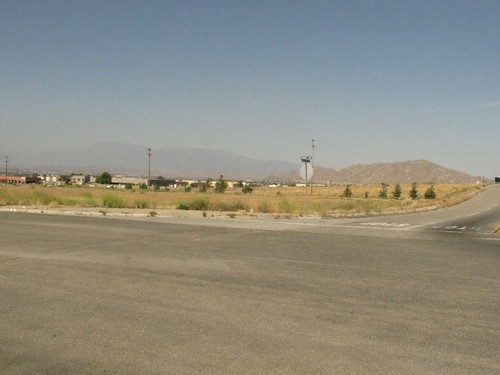
Yes, ladies and gentlemen, that is the proposed site of the new "Riverside" high-speed rail station. As you can see on the map above, it's not in Riverside, nor even Moreno Valley. It's in the unincorporated community of Mead Valley, just across the freeway from Perris. There is no transit nearby, no houses nearby, no meaningful commerce nearby- unless, of course, you'd like to buy surplus building materials or ship a few tons of air freight. Here's another view:

IMG_5099

I even caught a few panoramic shots of the location, so you could see the abject nothingness of it all:

2011-06-04 16.40.07

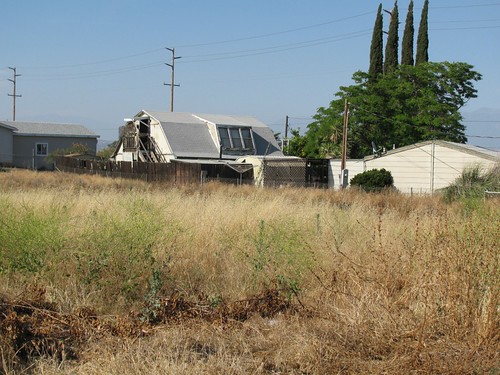
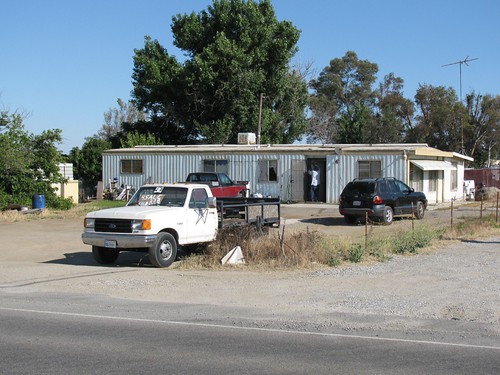
And, by the way, the site eschews the most populous and vibrant city in the Inland Empire for a community that looks like this:

IMG_5111

IMG_5114

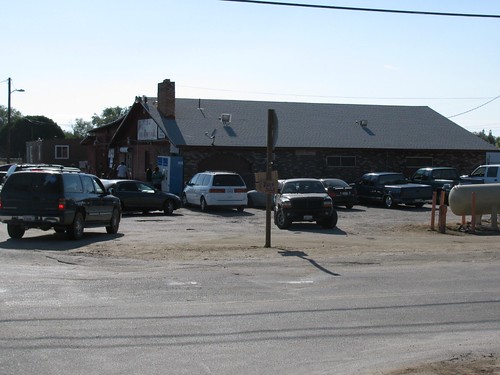
Now, I mean no disrespect to those who live in rural communities, but this is not a place for a high-speed rail station. If you want to bring infrastructure here, try bringing sewers and gas lines- most residents are on septic tanks and have to purchase propane from the local general store. Oh, yeah, there's a local general store:

IMG_5115

This is not the sort of downtown-to-downtown service that the Authority promised us.

There is an alternative. While the authority never considered a downtown Riverside station (and for good engineering reasons- turns out they need to build the system so that trains can pass through all but the termini at speed), they did consider two others in Riverside proper: one at Watkins and Blaine St. and one at I-215 and MLK. The one at Watkins and Blaine was removed from consideration due to expected community opposition- the University Neighbourhood Association killed a rather-minimal Metrolink station at the site, so an HSR station would probably be unthinkable- but the I-215/MLK station was removed for much shoddier reasons.

You see, both the Mayor and UCR's Executive Vice-Chancellor wrote letters to the Authority specifically requesting that the station be put at March Field. I don't know about the Mayor's reasoning, but UCR asked that the station be put at March Field instead because the UCR 20-year plan calls for PARKING STRUCTURES, not a high-speed rail station, around the overpass where the station would be.

Now, if I'm a student at UCR in 2031, when gas prices are so high that only the well-off can afford to drive, I wonder what would be more useful to me: a bunch of parking structures, or a high-speed rail link to the rest of the state? Also, while UCR has literally acres of land on which to build more parking, the HSR station can only go in a few places. If it's a choice between right on campus (full disclosure: literally steps from my office) and Mead Valley, I say we convince the campus to move their parking structures.

UPDATE: I should probably mention that the photos that weren't taken at the station site were taken on the bike ride to the site, as it is 1.5 miles from the nearest transit line (the 22).

Monday, November 15, 2010

Bicycle Lounge at UCR

The Bicycle Lounge, Riverside's first- and only- bicycle collective, is now open at UC Riverside. They'll be teaching folks how to fix their own bikes- and providing tools and parts- from 11:00-14:00 on Tuesdays in the Rec Centre parking lot, lot 24. For those who have to bring their bikes in by car, metered parking is available.

They also have hours downtown, at the Culver Centre for the Arts, 12:00-16:00 on Saturdays until the end of the Re:Cycle exhibit.

Wednesday, July 28, 2010

Why Don't We Have This?

My readers are most certainly aware of the concept of the universal transit pass- everyone at a given organization or institution gets an all-access transit pass at no cost to them, and the institution pays a deeply discounted rate for said passes. Here in Riverside, college students at UCR, La Sierra, Cal Baptist, and the Riverside and MoVal campuses of RCC get these sorts of passes, as do City of Riverside employees. However, in Riverside, each of these agreements was negotiated separately, the terms of each of them are different, and the contracts have to be renewed individually on a yearly basis. In fact, the names of the various college passes are different: UCR's program is called U-PASS, RCC's GO-PASS, and I'm unsure about which name the other campuses fall under. If you're a large employer in the region who wanted to offer transit benefits to your employees right now, you would have to devote substantial staff time and resources to approaching RTA and developing your own unique agreement with them- something you're probably not likely to do. However, it benefits employers, employees, RTA and the region to develop these sorts of programs- employers and employees both get tax breaks, employers often see lower absenteeism, employees don't have to pay for their transportation, RTA gets a steady source of revenue, and the whole region benefits from better transit services, cleaner air, and fewer cars on the road.

Fortunately, there is a better model. Those who have read Donald Shoup's epic "The High Cost of Free Parking" will know that I'm talking about the Santa Clara Valley Transportation Authority's Eco Pass program in the San Jose area. Organizations purchase passes for all of their employees on an annual basis. The passes are heavily discounted- the most expensive Eco-Pass agreement is $144/employee/year- and they entitle holders to use of every VTA transit service, be it local or express bus or light rail. The agency then provides support to the organization in the form of occasional on-site visits for promotions, personalized trip planning, and guaranteed ride home programs in case of employee or family emergencies. (A guaranteed ride home program already exists in Southern California, as a stand-alone program.)

But wait, there's more! VTA also offers Eco Passes to residential communities of 25 units or more. The most expensive pass plan would amount to a $20/month rent hike. Apartment communities, condos and homeowners' associations are allowed to buy passes for every resident over 5 years of age in their community, and those residents are then given a photo ID pass that entitles them to access to every VTA transit vehicle.

Even better than the benefits that occur directly because of the Eco Pass program are the ways that some cities in Silicon Valley are using these programs. Shoup cites Redwood City and Palo Alto as using the Eco Pass as a way to change the urban form of their communities. Properties that agree to provide Eco Passes to employees or residents gain substantial reductions to their minimum parking requirements, allowing them to build more housing/office space in less space. Compared to the cost of maintaining the parking spaces, the Eco Pass is often significantly cheaper, and it saves the cities from being blighted with yet more surface parking.

The three-tier pricing structure that Eco Pass uses appears to be tied in with how likely employees are to switch to transit: the heavily-served downtown area of San Jose is the most expensive, followed by areas within 1/4 mile of a light rail station (people are more likely to ride the train), and then everywhere else. If we were to set up a similar system in Riverside County, I suggest the following three categories: Downtown Riverside, Riverside/Moreno Valley, and elsewhere in the county. Also, our prices ought to be quite a bit lower than VTA's, considering the difference in service offered. For reference, a general VTA Express monthly pass runs $140, while our equivalent Commuterlink 30-day pass costs $75. If we accept the ratio of these two passes as the appropriate difference in cost for Eco Passes, we come up with the following pricing structure for businesses in the RTA service area. Keep in mind that these are ANNUAL prices, and none of them exceeds the cost of the equivalent 30-day pass:


RTA Business1-99100-2,9993,000+*
Downtown Riv.74.8856.1637.44
Riv/MoVal56.1637.4418.72
Other37.4418.729.36


RTA Residential1-99100-2,9993,000+*
Downtown Riv.62.4046.8031.20
Riv/MoVal46.8031.2015.60
Other31.2015.607.80


* I don't think that there are any employers or apartment complexes in the I.E. with over 15,000 employees/residents. I could be wrong, of course.

So RTA, your part is to establish this program, connect it to the existing Guaranteed Ride Home infrastructure, and offer it to employers and residential communities.

City of Riverside, you should provide incentives for developers and companies to sign their properties up with this program when they apply for permits, by reducing the number of parking spaces required, allowing density bonuses, and other no-cost zoning law changes that could really improve the urban form of our city.

How about it?

Tuesday, June 1, 2010

NIMBY rage not satisfied with taking my train station, wants the whole PVL

Residents in the neighbourhood east of UC Riverside are really, really getting on my nerves. Were it not for their incessant complaining, the Perris Valley Line would already be up and running, and it would be stopping on my campus as well. RCTC officials delayed the project two years and removed the UC Riverside station to appease them, and yet they still aren't happy.

Ladies and gentlemen- YOU BOUGHT A HOUSE NEXT TO A TRAIN LINE. If, when you looked out the back windows of your home when considering buying it and saw train tracks, you didn't think "Hey, maybe trains call on this area from time to time. Trains are a deal-breaker for me, I should go look at that shiny McMansion in La Sierra or Woodcrest," then you are an idiot. You did not adequately consider all of the factors involved in the purchase of your home, and you are asking the entire I-215 corridor to suffer on account of your shortsightedness. This is ridiculous- either shut up or move.

I lived on Watkins Avenue immediately across from the train tracks for a year- the freighters that came through at night were noisy, yes, but we got used to it. And Metrolink trains will be MUCH quieter than freight trains, considering their comparatively light weight, minimal length and higher speed. Furthermore, the PVL line improvements will actually make EVERY train that passes through your neighbourhood less noisy- the standards to which passenger tracks must be built are higher, and the tighter tolerances mean less noise. If you knew a damned thing about trains (which you don't, obviously), you'd ask for the project to be built with a quiet zone at the two grade crossings, rather than all of these sound walls and window treatments that even you all can't agree on. And the safety arguments are crap. You're seriously shouting "Won't somebody think of the children?!?!" in this debate? Once again, track improvements will mitigate any chance of derailment or disaster- and when freighters and Metrolink trains go by, for the most part, your precious little snowflakes won't be in school! Metrolink trains run during commute hours, and freighters travel that route late at night. If your child is still in school at 5pm, I think you have bigger things to worry about than this train thing.

Seriously, Watkins Avenue neighbourhood- it's six measly trains a day. Odds are you'll be off in your SUVs to your jobs for at least a few of them. It won't be as bad as you think- in fact, it might be better than the trains that already rumble past your homes- and at any rate, you have no right to complain, because YOU BOUGHT A HOUSE NEXT TO A TRAIN TRACK. (Normally, I'm not a big fan of arguments like that- often, it's low-income residents who can't afford to live anywhere else. Not in this case- that's a very affluent middle-class neighbourhood.) There is only one place for any sort of eastward rail line to leave Riverside on the current rail network, it goes by your house, so bloody deal with it.

Worst of all, this article quotes Save Riverside's Kevin Dawson as part of the Watkins Avenue Resistance- Mr. Dawson was formerly a contact of mine when we were dealing with the Greyhound debacle last year. It just goes to show you that there is no concerted coalition for transit and livability out here in Riverside. (Note: Kevin mentions in the comments that, while he is affiliated with Save Riverside, his advocacy on this issue is related to his membership in the University Neighborhood Association.)

Thursday, April 22, 2010

Happy Earth Day, and Perris Valley Line Update

Today is April 22, and that means it's the 40th celebration of Earth Day. Today, when you're out travelling, make the environmentally responsible choice- go by train, bus, bike or foot.

Also, in response to a reader e-mail, I wanted to update you all on the Perris Valley Line. The RCTC released a new Draft Environmental Impact Report, detailing the project and its various impacts to the surrounding community in an attempt to assuage the concerns of local residents (read NIMBY's). While the project is far from derailed, the most significant change is the elimination of a UC Riverside station on the line, due to opposition about noise concerns from residents in the neighbourhood. The Commission had previously conceded every parking space at the station (something I supported) to alleviate traffic noise, but apparently that wasn't enough. A key thing to keep in mind is that the California HSR Authority plans to put the Riverside HSR station approximately where that Metrolink station was going to be. If the residents couldn't put up with the likely 4-5 trains per day, they won't be happy about HSR either.

If you'd like to comment on the proposed EIR, there is a public hearing tonight at 6pm at the Perris City Council Chambers, at the corner of Perris & San Jacinto in Perris and a few blocks' walk from the Perris Transit Centre, which is served by routes 19, 22, 27, 30, 74, 208, and 212 (though carefully check the schedule if you plan on using the 208 or 212). You can also mail comments to RCTC at:

Attn: Eliza Echevarria
RCTC
P.O. Box 12008
Riverside, CA 92502

until May 24th.

Friday, April 16, 2010

Drunk Driving and Creative Transit Funding

So my wife and I were talking about drunk driving and alternative transportation while waiting for the 16 today (to go pick up a ZipCar- we're just an alt-transport couple like that), and I was telling her that, while drunk drivers are certainly irresponsible and should be punished, they're just a symptom of a larger problem with our society. I don't have the statistics to back this up, but I suspect that drunk driving fatalities are probably significantly lower, per capita, in large cities with extensive 'round-the-clock transit networks like New York or San Francisco. (If anyone has city or county-level data on the subject, let me know- Google keeps giving me links to attorneys.) The fact is that, after going out for a night on the town, in most cities there are few options for getting home afterwards. Designating a driver is, of course, the responsible choice, but being the designated driver sucks so very, very much. Calling a taxi is always an option, but taxis are not cheap. (UCR students- if you are out drinking and need to call a cab, you can do so free of charge anywhere in the City of Riverside, by calling 951-UCR-TAXI [951-827-8294].) Cycling is subject to the same DUI penalties (CVC 21200.5) as driving. (Commenter Peter notes that penalties for cycling under the influence may be significantly less than driving under the influence. It's still at least a $250 fine, so still not a recommended option.) That leaves walking, and that's a great option if you live within walking distance of your local watering hole, but that's rare in Riverside. (Also, if you're near UCR, you can take the late-night #53 shuttle, but only Monday-Thursday. I will confess to having used said route to bar-hop.) So, while it remains reprehensible behaviour, it is understandable why some people feel the urge to drink and drive.

Of course, our transit system is in dire funding straits, and late-night service is simply not an option for RTA at the moment, and general taxation is a hard sell in this area under even good economic times. So what's to be done?

I propose that the City impose an excise tax on drinks served in restaurants and bars- nothing excessively large, but $0.05 per serving of alcohol should do. (A serving is a pint of beer, a glass of wine, or an ounce of hard liquor.) This would add a nickel to the price of a pint or a glass of wine, 18 cents to a 60oz pitcher, and 13 cents to each martini- probably not enough of a difference that anyone would cut back on their alcohol consumption, but enough to scare up a bit of funding. This funding would be reserved for public transit service, and transit agencies could only tap into the funding if they run service past last call (2am here). The public has consistently shown support for "sin taxes"- look at the continually rising excise taxes on cigarettes, and yet another initiative raising them looks poised to pass this fall. Restaurateurs and barkeeps would be permitted to simply add the extra nickel to each drink (as if they wouldn't anyway) and send in the proceeds with their ordinary sales tax receipts. Those who pay the tax would receive direct benefits in the form of safe, reliable transportation home after a night out. Implemented properly, this policy might even increase sales at bars and restaurants- no more need for one member of the party to remain stubbornly sober, and a flood of car-free collegiate beer drinkers headed downtown to party.

Now, I'm not certain of all of the legal issues surrounding the implementation of this sort of plan, or even if such a tax would raise enough money to pay for late-night transit service. (I can't imagine a skeletal late-night network would cost that much, all things considered, but I have been wrong before.) However, in these budgetary times it's important to be creative while looking for ways to improve our transportation system and urban environment, and it's at least worth a shot.

What do you all think?

Thursday, February 4, 2010

Zip!


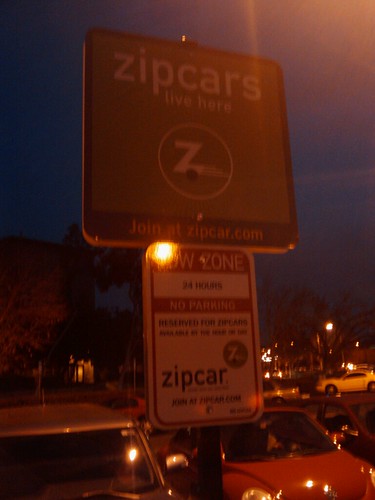
Something on my never-gonna-happen list happened today. No, RTA didn't announce plans for the Magnolia Avenue Rapid Streetcar, but it's ALMOST that awesome. Riverside is now the first city in the Inland Empire with car-sharing, as Zipcar is now available in two locations on the UC Riverside campus. (Prior to this, the closest Zipcar to us was on the campus of the Claremont Colleges in Claremont- ALMOST in the IE, but not quite.)

Car-sharing is an excellent alternative for those who want to live in suburbia without owning a car. Let's face it- most people will find a need for an automobile at least on occasion out here in the IE. An occasional need for a car does not warrant keeping one in the garage 24/7, though, and ZipCar makes it VERY easy to shed that unnecessary vehicle.

UC Riverside students, faculty and staff are obviously encouraged to join (with insanely low rates- $35/year, with no application fee and no minimums), but members of the community are also permitted to do so (without the insanely low rates).

Let's hear it for the progressive people at UCR's Transportation and Parking Services, for turning never-gonna-happen into happened-Monday.